This guide is not another list of passive income ideas. It is a diagnosis of the 10 biggest mistakes that separate the 12% who succeed from the 88% who fail — with real data, honest timelines, and specific corrections for each mistake. If you are new to passive income and want to understand what it actually means before diving into the mistakes, start with our guide on what is passive income, really. If you want a full list of proven ideas with real earnings data, see our guide on passive income examples that actually work.
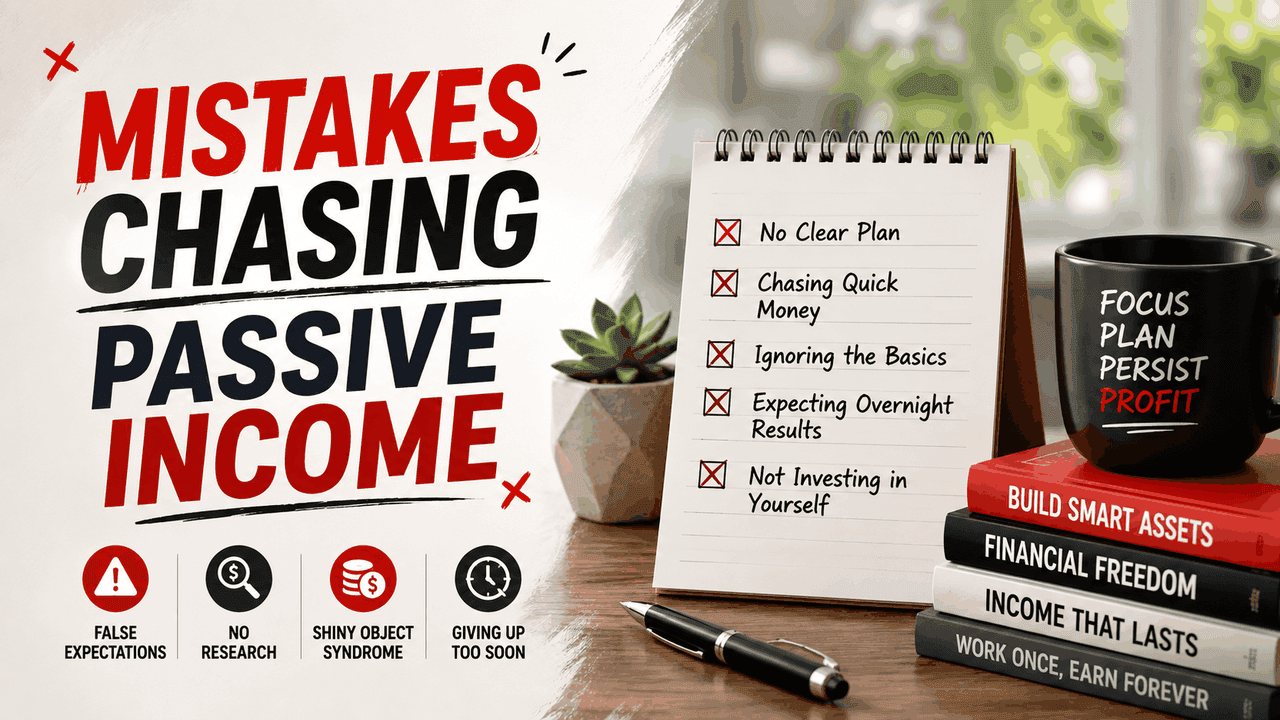
Mistake 1: Believing Passive Income Is Effortless
This is the most expensive mistake because it shapes every other decision. The word "passive" does not mean "no work." It means "work done upfront that continues to pay later." A dividend stock pays quarterly because you researched and bought it. A digital product sells while you sleep because you spent 40 hours creating it. A rental property generates cash flow because you purchased it, found tenants, and set up management systems.
The 2026 analysis is clear: "truly passive income does not exist. What does exist is leveraged income — business models where the effort-to-income ratio improves significantly over time. But every 'passive' income stream requires substantial upfront work, ongoing maintenance, or both."
| Stage |
What Actually Happens |
Time Required |
| Research & planning |
Evaluating options, studying markets, choosing a strategy |
3–6 months |
| Setup & implementation |
Building systems, creating products, buying assets, launching |
6–12 months |
| Optimization & growth |
Refining strategies, scaling what works, cutting what does not |
Ongoing |
| True "passive" phase |
Income flows with minimal intervention |
1–3+ years after start |
The correction: Stop looking for the idea that requires zero work. Start looking for the idea where your upfront work produces the highest long-term return per hour. A digital product that takes 60 hours to create and earns $500 per month for two years produces an effective hourly rate of $200. That is leveraged income. But it is not effortless income.
💡 Pro tip: Before starting any passive income stream, calculate your actual hourly rate for the setup phase. If you spend 100 hours creating a digital product that earns $50 per month, your effective hourly rate over two years is $12. That is below minimum wage. The math matters more than the idea.
Mistake 2: Expecting to Get Rich Quick
The get-rich-quick narrative is the engine that drives the multi-billion-dollar passive income education industry. Gurus sell courses, masterminds, and "done-for-you" systems that promise $10,000 per month in 90 days. The reality is that substantial passive income takes years, not months, to develop.
According to a 2026 analysis, the realistic timeline is: 3–6 months of research and preparation, 6–12 months of setup and implementation, and then ongoing growth and optimization. Substantial income from passive sources typically takes several years to develop. The bloggers showing $10,000 per month screenshots are usually 3–5 years into their journey, not 3–5 months.
| Timeline Expectation |
What Actually Happens |
Quit Rate |
| Month 1–3 |
Near-zero income; learning curve is steep |
35% quit here |
| Month 4–6 |
First small sales or commissions appear ($50–$200/month) |
25% more quit |
| Month 7–12 |
Income begins compounding ($200–$500/month) |
15% more quit |
| Year 2 |
Meaningful income emerges ($500–$1,500/month) |
10% more quit |
| Year 3+ |
Significant passive income possible ($1,500+/month) |
Survivors only |
The correction: Plan for 12 months before judging any passive income stream. Set a goal of $100 per month by month 6, not $5,000 per month by month 3. The people who stick past month 6 are disproportionately represented among those earning real income by month 12.
💡 Pro tip: The fastest way to quit is to set unrealistic timeline expectations. If you expect $1,000 per month by month 3 and earn $50, you will feel like a failure and quit. If you expect $100 per month by month 6 and earn $150, you will feel like you are ahead of schedule and keep going. Your expectations determine your behavior more than your actual results do.
Mistake 3: Buying Courses Instead of Doing the Work
The passive income education industry is a multi-billion-dollar business, and most of it sells motivation rather than mechanics. A $997 course on "how to make passive income" is rarely worth more than 20 hours of free YouTube tutorials and one month of actual execution. Beginners who spend more time buying courses than building products will always be beginners.
The 2026 data on this is stark: the average aspiring passive income earner spends $500–$2,000 on courses, tools, and "systems" before earning their first dollar. That same capital, invested in a dividend ETF, would generate $20–$80 per year in actual passive income. Or that same time, spent creating a digital product, would produce an asset that sells for years.
| Expense Category |
Typical Cost |
Actual Value |
| "Passive income" course |
$497–$2,997 |
Often repackages free information |
| "Done-for-you" system |
$1,000–$5,000 |
Usually requires significant additional work |
| Premium tools (before needed) |
$100–$500/month |
Often overkill for beginners |
| Coaching program |
$5,000–$25,000 |
Valuable only if you already have a business to optimize |
| Total spent before first dollar |
$500–$2,000+ |
Could have been invested in actual assets |
The correction: Spend $0 on courses until you have earned your first $100 from a free resource. YouTube, free blog posts, and platform documentation contain 90% of what you need to start. Pay for education only after you have a specific, identified gap that free resources cannot fill — not before you have started.
💡 Pro tip: The most valuable "course" is the one you create for yourself by doing the work, failing, adjusting, and documenting what you learned. A beginner who creates one digital product, lists it, gets zero sales, analyzes why, adjusts the listing, and tries again learns more in 30 days than someone who watches 100 hours of course content without taking action.
Mistake 4: Quitting Before Month Six
Search engines take time to trust and rank new content. Most blogs see negligible traffic for the first 3 months, and many quit exactly when the growth curve is about to bend upward. The bloggers who stick past month 6 are disproportionately represented among those earning real income by month 12.
The 2026 data confirms this pattern. Only 26% of bloggers earn anything within 6 months. The median time to earn a first dollar is 12 months. Yet 60% of beginners quit within the first 6 months — right before the compounding effect kicks in.
| Milestone |
Percentage Still Active |
Typical Monthly Income |
| Month 1 |
100% |
$0 |
| Month 3 |
65% |
$0–$50 |
| Month 6 |
40% |
$50–$200 |
| Month 12 |
25% |
$200–$800 |
| Month 24 |
15% |
$800–$3,000 |
| Month 36 |
10% |
$3,000+ |
The correction: Commit to 12 months before judging results. Set process goals (publish 2 posts per week, create 3 digital products, write 20 affiliate articles) instead of outcome goals (earn $1,000 per month). Process goals are within your control. Outcome goals depend on algorithms, markets, and timing — all outside your control.
💡 Pro tip: The single biggest predictor of passive income success is not talent, niche selection, or startup capital. It is persistence past month 6. If you can commit to showing up consistently for 12 months, you are already in the top 25% of competitors — most of whom will have quit by then.
Mistake 5: Confusing Portfolio Income With Passive Income
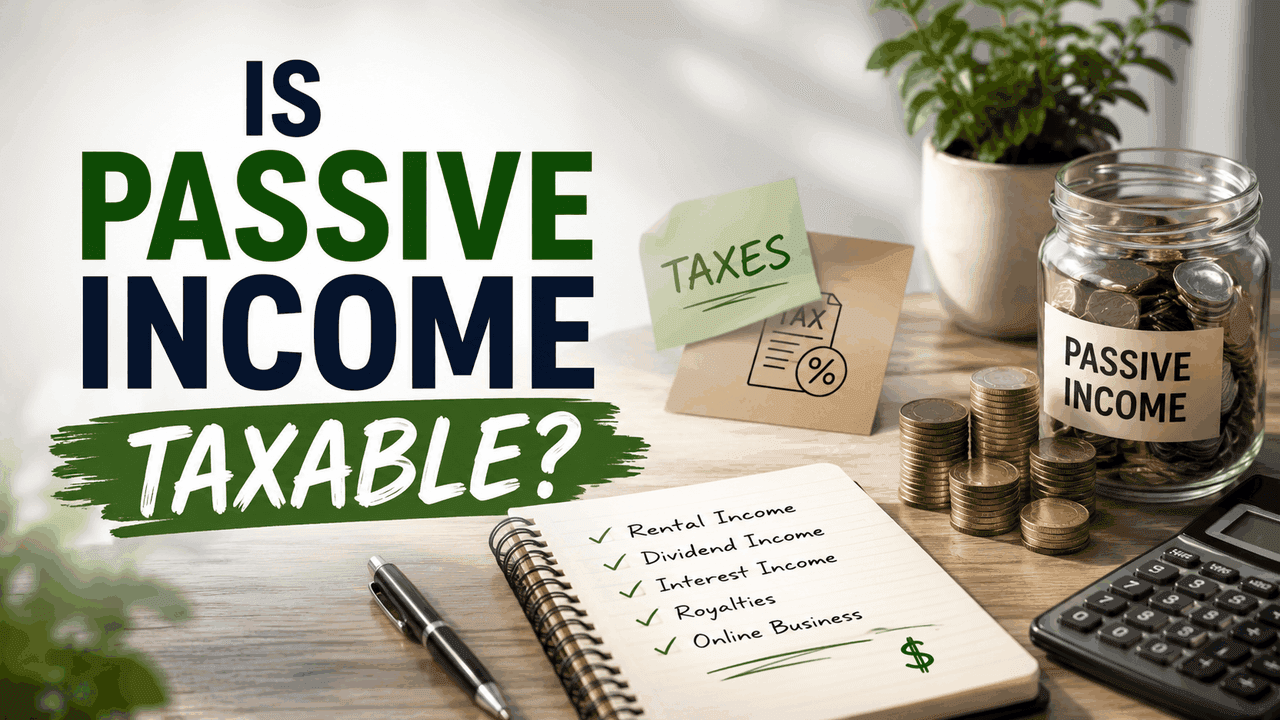
This mistake costs people money at tax time and leads to bad investment decisions. The IRS does not classify dividends, interest, or capital gains as passive income. Those are portfolio income, with their own tax rules. Passive income, under IRS rules, is net rental income and income from businesses where you do not materially participate.
The confusion matters because portfolio losses (like capital losses) follow completely different rules than passive activity losses. You cannot use passive activity losses to offset dividend income. Many taxpayers mistakenly try to deduct rental losses against their dividend income, which is not allowed.
| Income Type |
IRS Classification |
Tax Treatment |
Deductible Losses? |
| Rental income |
Passive |
Ordinary income, Schedule E |
Yes — passive losses offset passive income; $25K allowance |
| Dividends |
Portfolio |
Capital gains rates (if qualified) |
No — capital losses have separate rules |
| Interest |
Portfolio |
Ordinary income |
No |
| Capital gains |
Portfolio |
Capital gains rates |
Offset by capital losses |
| Digital product sales |
Active (if you create) or Passive (if entity-run) |
Ordinary income + SE tax if active |
Business expenses only if active |
The correction: Know which bucket your income falls into before you plan your tax strategy. If you are deducting rental losses, make sure you understand the passive activity loss rules, the $25,000 special allowance, and the at-risk rules. For the full tax breakdown, see our guide on is passive income taxable.
💡 Pro tip: The most expensive tax mistake is not underpaying — it is missing deductions you were entitled to because you did not understand the rules. A real estate investor who does not claim the $25,000 special allowance or bonus depreciation leaves thousands of dollars on the table every year.
Mistake 6: Relying on a Single Income Stream
Relying on a single income stream — passive or otherwise — is risky. Platform changes, market shifts, or algorithm updates can wipe out a single-source income overnight. The most financially resilient earners build multiple streams over time.
The 2026 data shows that bloggers and creators who diversify across at least three income streams earn 3–5x more than those relying on a single stream. A blog with display ads, affiliate marketing, and a digital product is far more resilient than a blog with display ads alone. A real estate investor with properties in two markets is safer than one with everything in a single city.
| Stream Count |
Typical Monthly Income |
Resilience |
| 1 stream |
$200–$1,000 |
Fragile — one algorithm change can cut income 50%+ |
| 2 streams |
$500–$2,500 |
Moderate — some protection, but both could be correlated |
| 3+ streams |
$1,500–$5,000+ |
Strong — diversified across platforms, markets, and models |
The correction: Start with one stream, master it until it produces consistent income, then add a second. Once the second is stable, add a third. Do not try to launch five streams simultaneously — you will master none. But do not stay on one stream forever. Diversification is not just for investment portfolios.
💡 Pro tip: The ideal passive income portfolio combines three models: one capital-based (dividends, REITs), one creation-based (digital products, affiliate content), and one asset-based (rentals, equipment rental). Each model responds differently to economic conditions, so the combination smooths your overall income. For a full comparison of how different passive income models work, see our guide on passive income vs side hustle.
Mistake 7: Underestimating the Upfront Work
Every passive income stream requires upfront value creation. A dividend stock pays because you researched and bought it. A digital product sells because you created it. A rental property generates cash flow because you purchased it and set up systems. The upfront work is the price of admission, and there is no way around it.
The most common manifestation of this mistake is creating a low-quality product in 2 hours and expecting it to sell. A budget template thrown together in an afternoon will not compete with a professionally designed template that took 20 hours. A blog post written in 20 minutes will not rank against a 3,000-word research-backed post that took 8 hours.
| Stream |
Minimum Upfront Work |
Typical First-Year Income |
| Digital product |
20–60 hours |
$200–$500/month |
| Affiliate blog |
40–100 hours |
$100–$400/month |
| Rental property |
100–200 hours + capital |
$200–$800/month |
| Dividend investing |
10–20 hours (research) |
$33–$167/month (on $10K–$50K) |
| YouTube channel |
60–120 hours |
$0–$200/month (pre-monetization) |
The correction: Budget 2–3x more upfront time than you think you need. A digital product you think will take 10 hours will actually take 30 hours when you factor in research, design, testing, and marketing. The creators earning $5,000+ per month are not working less than beginners — they already did the upfront work that beginners are still avoiding.
💡 Pro tip: The 80/20 rule applies to upfront work: 80% of your results come from 20% of your effort. But you cannot identify which 20% matters until you have done the other 80%. There is no shortcut to discovering your highest-leverage activities. You have to do the work first.
Mistake 8: Ignoring the Tax Implications
Passive income is taxable, and the rules are specific enough that getting them wrong costs money. Digital product sellers, affiliate marketers, and rental property owners who do not set aside 20–30% of their passive income for taxes get an unpleasant surprise at tax time. Self-employed individuals who do not make quarterly estimated payments face penalties even if they owe nothing when they file.
The 2026 tax picture is complex. Rental income is ordinary income with deductible expenses and depreciation. Qualified dividends get lower capital gains rates. REIT dividends are mostly ordinary income but may qualify for the 20% QBI deduction. Digital product and affiliate income is ordinary business income subject to 15.3% self-employment tax on $400 or more. And high-income earners face an additional 3.8% Net Investment Income Tax.
| Income Type |
Federal Tax Rate |
Self-Employment Tax? |
NIIT (if MAGI >$250K MFJ)? |
| Rental income |
10%–37% |
No |
Yes |
| Qualified dividends |
0%, 15%, or 20% |
No |
Yes |
| REIT dividends |
10%–37% (mostly) |
No |
Yes |
| Digital products (active) |
10%–37% |
Yes — 15.3% on $400+ |
No |
| Affiliate commissions |
10%–37% |
Yes — 15.3% on $400+ |
No |
The correction: Set aside 25–30% of all passive income for taxes from day one. Open a separate savings account labeled "taxes" and transfer the money there immediately when income arrives. If you expect to owe $1,000 or more, make quarterly estimated payments. And consult a tax professional once your monthly passive income exceeds $500 — the cost of professional advice is far less than the cost of a mistake.
💡 Pro tip: The tax difference between a side hustle and passive income can be significant. A side hustler earning $1,000 per month might owe $250–$400 in taxes after self-employment tax and income tax. A passive income investor earning $1,000 per month in qualified dividends might owe $0–$150 depending on their tax bracket. That is not tax avoidance — it is tax structure. For the complete tax breakdown, see our guide on is passive income taxable.
Mistake 9: Starting With the Wrong Idea for Your Resources
A beginner with $100 who tries to buy a rental property will fail before they start. A beginner with 40 hours per week who picks a strategy meant for someone with 2 hours per week will burn out. The right passive income idea is the one that matches your available capital, your available time, and your actual skills — not the one that sounds the most impressive on social media.
The 2026 data makes this clear. Only 12% of Americans pursuing secondary income earn meaningful passive income above $500 per month. The gap is not about intelligence or luck. It is about starting with the wrong idea for their current resources.
| Your Resource |
Best Starting Point |
Worst Starting Point |
| $0 capital, 15+ hours/week |
Digital products, affiliate marketing, print-on-demand |
Rental property, dividend investing (no capital) |
| $5,000 capital, 5 hours/week |
Dividend ETFs, REITs, high-yield savings |
Digital products (not enough time to create quality) |
| $50,000 capital, 2 hours/week |
Rental property, real estate crowdfunding, dividend portfolio |
Affiliate blog (not enough time to produce content) |
| Unpredictable schedule, $0 capital |
Digital products, stock photography, print-on-demand |
Rental property (requires tenant management) |
The correction: Inventory your resources honestly before picking an idea. How much capital do you have? How many hours per week can you dedicate? What skills do you already have? Then match your idea to those resources, not to your aspirational resources. For a full list of ideas organized by capital level, see our guide on beginner passive income ideas. If you are starting with no money at all, see our guide on passive income with no money.
💡 Pro tip: The most successful passive income earners are not the ones who found the "best" idea. They are the ones who found the idea that matched their actual situation and then outlasted everyone else. A mediocre idea executed consistently for 24 months beats a brilliant idea abandoned after 3 months.
Mistake 10: Treating Passive Income as a Replacement for a Job Too Soon
Passive income can supplement your earnings, but it rarely serves as a sole source of income right away. The journey involves considerable time and financial investment without immediate returns. Market shifts, property vacancies, and algorithm changes can impact earnings, introducing financial unpredictability that a regular salary does not have.
Replacing a $50,000 annual salary with passive income requires roughly $1,250,000 invested at a 4% yield, or a portfolio of digital products selling at scale, or multiple rental properties generating consistent cash flow. Most people build passive income as a supplement first, then gradually grow it toward replacement level over several years.
| Goal |
What It Actually Requires |
Realistic Timeline |
| Earn $500/month |
One established stream (digital product, affiliate blog, or $150K invested) |
12–18 months |
| Earn $1,500/month |
Two–three diversified streams or $450K invested at 4% |
2–3 years |
| Replace $50K salary |
$1.25M invested at 4%, or 5+ rental properties, or a scaled digital product business |
5–10 years |
| Full financial independence |
$2M+ invested at 4%, or a multi-stream portfolio generating $6K+/month |
10–15 years |
The correction: Treat passive income as a supplement, not a replacement, for the first 2–3 years. Keep your day job. Build your passive streams on evenings and weekends. Only consider reducing your active work once your passive income consistently covers 50% of your expenses for 12 consecutive months. The people who quit their jobs at month 6 because their blog earned $800 one month are the ones who end up in financial trouble when the next month drops to $200.
💡 Pro tip: The safest transition from active to passive income is gradual. Reduce your day job hours from 40 to 35, then 30, then 25 — while your passive income grows. This gives you time to learn whether your passive income is truly stable or just temporarily high. A salary is predictable. Passive income is variable. Do not trade predictability for variability until you have proof the variability is manageable.
Real-World Scenarios: What Happens When You Make These Mistakes
Here are three realistic scenarios showing how these mistakes play out in practice — and how to correct them.
Scenario 1: The Course Collector Who Never Starts
Alex has spent $3,500 on passive income courses over 18 months. He has watched 200+ hours of content, taken detailed notes, and joined three private communities. He has earned $0. His mistake: buying education instead of taking action.
| Metric |
Value |
| Total spent on courses |
$3,500 |
| Total hours consumed |
200+ |
| Total income earned |
$0 |
| If same capital invested in SCHD |
$140/year in dividends |
| If same time spent creating a product |
Likely $200–$500/month by now |
The correction: Alex should stop buying courses immediately. He should pick one free resource — a YouTube channel, a blog, or a platform's own documentation — and follow it to create one digital product or write 10 blog posts. Action produces income. Consumption produces only the illusion of progress.
Scenario 2: The Blogger Who Quits at Month 4
Priya started a personal finance blog in January. She published 15 posts in the first 3 months, saw almost no traffic, and quit in April. Her mistake: quitting before the compounding curve bent upward.
| Metric |
Value |
| Posts published |
15 |
| Month 3 traffic |
~200 monthly pageviews |
| Month 3 income |
$0 |
| What month 6 might have looked like |
~1,500 pageviews, $50–$100 affiliate income |
| What month 12 might have looked like |
~5,000 pageviews, $300–$500 affiliate income |
The correction: Priya should have committed to 12 months before judging results. Most blogs see negligible traffic for the first 3–6 months. The growth curve bends upward between months 6 and 12, not between months 1 and 3. Her 15 posts were an investment in future rankings, not a failure — but she cashed out her investment early by quitting.
Scenario 3: The Real Estate Investor Who Ignored Taxes
David bought a rental property and earned $18,000 in gross rent his first year. He spent $28,000 on expenses, producing a $10,000 loss. He did not track his MAGI, which was $115,000. He assumed he could deduct the full $10,000 loss against his wages.
| Tax Element |
What David Thought |
What Actually Happened |
| Expected deduction |
$10,000 full loss against wages |
Only $17,500 allowance available (phase-out applied) |
| Actual deductible loss |
$10,000 |
$10,000 (full loss, since $10,000 < $17,500 reduced allowance) |
| Tax savings |
$2,200 (at 22% rate) |
$2,200 |
| Risk if MAGI were $140K |
Would have assumed full deduction |
Only $5,000 deductible; $5,000 carried forward |
David got lucky — his loss was small enough that the phase-out did not fully eliminate his deduction. But if his loss had been $20,000 and his MAGI $140,000, he would have been able to deduct only $5,000 and would have carried forward $15,000 — a $3,300 tax surprise he did not plan for.
The correction: David should track his MAGI quarterly, not just at tax time. He should understand the $25,000 special allowance phase-out rules before buying his next property. And he should set aside 25% of his rental income for taxes from day one, even in loss years, because depreciation recapture and capital gains taxes will hit when he sells.
The Honest Path to Passive Income
Here is what no guru will tell you: the path to real passive income goes through active income first.
- Build a skill: Get good at something people will pay for — writing, design, analysis, teaching, or a specific technical skill.
- Serve clients actively: Trade time for money while you learn what the market actually wants and what you are actually good at.
- Systemize what works: Turn your process into a repeatable system. Document everything.
- Productize: Package your system into something that scales — a course, a template, a guide, or a tool.
- Automate and delegate: Remove yourself from the day-to-day. Hire help, build automation, and let the system run.
This process takes 2–5 years for most people. That is not sexy, but it is real. The entrepreneurs who achieve genuine financial freedom are not the ones who found a hack. They are the ones who did the work, built the systems, and stayed the course.
| Stage |
Timeline |
What You Are Doing |
| Skill building |
Year 1 |
Learning, practicing, getting paid for active work |
| Systemization |
Year 1–2 |
Documenting processes, identifying what scales |
| Productization |
Year 2–3 |
Creating digital products, courses, or assets |
| Automation |
Year 3–5 |
Hiring help, building automation, reducing personal hours |
| True leverage |
Year 5+ |
Income grows while personal effort stays flat or declines |
💡 Pro tip: If you are currently working a day job and want to build passive income, dedicate 5 hours per week to the skill-building stage. In one year, that is 260 hours — enough to become genuinely good at one valuable skill. In two years, that is 520 hours — enough to create a product, build a small audience, and start seeing compounding returns. The path is slow, but it is certain. The only variable is whether you show up.
Bottom Line
The 10 mistakes above are not theoretical. They are documented patterns that explain why 88% of people pursuing passive income never earn meaningful money from it. The 12% who succeed share a different pattern: they accepted the upfront work, set realistic timelines, avoided expensive courses, understood the tax rules, diversified their streams, matched their ideas to their resources, and gave it the years the data says it actually takes.
There is no passive path to wealth. But there is a leveraged one — and it starts with showing up today, doing the work that most people avoid, and outlasting everyone who quits before the compounding kicks in. Stop looking for shortcuts. Start building assets — skills, audiences, systems, products — that compound over time. That is how you win.
Frequently Asked Questions
What are the most common passive income mistakes?
The 10 biggest mistakes are: believing passive income is effortless, expecting to get rich quick, buying courses instead of doing the work, quitting before month six, confusing portfolio income with passive income, relying on a single stream, underestimating upfront work, ignoring tax implications, starting with the wrong idea for your resources, and treating passive income as a job replacement too soon.
Why does passive income fail for most people?
Passive income fails for most people because they never build the execution system needed before anything can become passive. Most income streams are not passive at the start — they require significant upfront work, ongoing maintenance, and patience through a slow compounding phase. The majority of beginners quit within 6 months, exactly when the growth curve is about to accelerate.
Is passive income a scam?
Passive income itself is not a scam — it is a real financial strategy. But the passive income education industry is filled with scams, overpriced courses, and get-rich-quick schemes that exploit unrealistic expectations. The FTC reported 29,419 income scams in 2020 through Q3, a 70% increase from the prior year. Legitimate passive income requires upfront work or capital, takes months or years to develop, and never promises effortless returns.
How long does passive income really take?
The realistic timeline is 3–6 months of research and planning, 6–12 months of setup and implementation, and then 1–3+ years before income becomes truly passive with minimal intervention. Most beginners see $100–$300 per month by month 6, $300–$500 per month by month 12, and $1,000+ per month only after 18–36 months of consistent effort.
Should I buy a passive income course?
No — not before you have earned your first $100 from free resources. YouTube, free blog posts, and platform documentation contain 90% of what you need to start. Pay for education only after you have a specific, identified gap that free resources cannot fill. Most $997 courses repackage information that is freely available and delay the actual work that produces income.
Why do people quit passive income before succeeding?
People quit because they set unrealistic timeline expectations, expect immediate results without upfront effort, get discouraged by near-zero income in the first 3–6 months, and compare their month 3 results to someone else's year 3 results. The growth curve for most passive income streams bends upward between months 6 and 12 — but 60% of beginners quit before reaching that point.
Can passive income replace my job?
Eventually, yes — but not quickly. Replacing a $50,000 annual salary requires roughly $1,250,000 invested at a 4% yield, or a scaled portfolio of digital products, or multiple rental properties. Most people should treat passive income as a supplement for the first 2–3 years and only consider reducing active work once passive income consistently covers 50% of expenses for 12 consecutive months.
What is the fastest way to build passive income?
There is no fast way to build meaningful passive income. The fastest paths to first income are asset-based: renting out a car on Turo, listing storage space on Neighbor, or wrapping your car with advertising. These can produce income within days or weeks. But for scalable, long-term passive income, creation-based streams like digital products and affiliate content produce the highest returns — after 6–18 months of upfront work.
How much money do I need to start passive income?
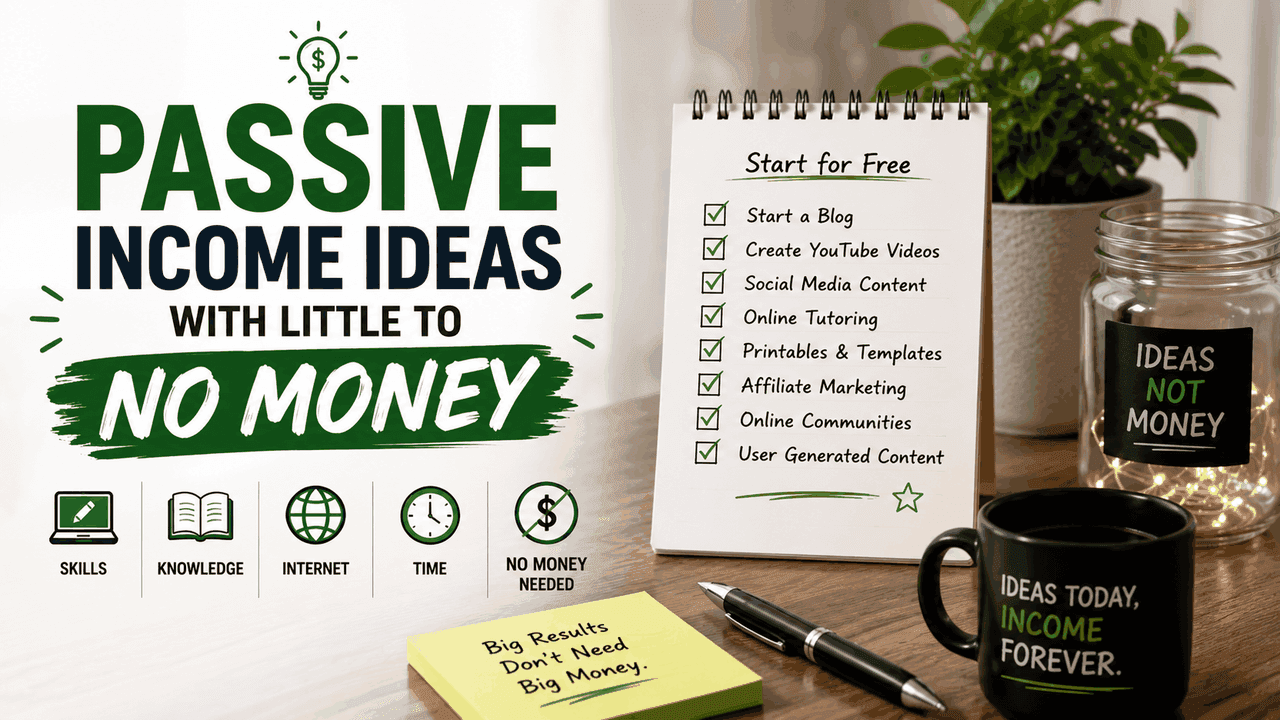
You can start with $0. Digital products, affiliate marketing, print-on-demand, and Amazon KDP all require no financial investment. Capital-based streams like dividend investing require as little as $1 per share through fractional investing. The real requirement is upfront time and effort, not money. Most people have more time than capital, which is why creation-based streams are the best starting point for beginners.
What is the honest path to passive income?
The honest path is: build a skill, serve clients actively while you learn, systemize what works, productize your expertise into scalable assets, and then automate and delegate. This process takes 2–5 years for most people. There are no shortcuts. The entrepreneurs who achieve genuine financial freedom are the ones who did the work, built the systems, and stayed the course.